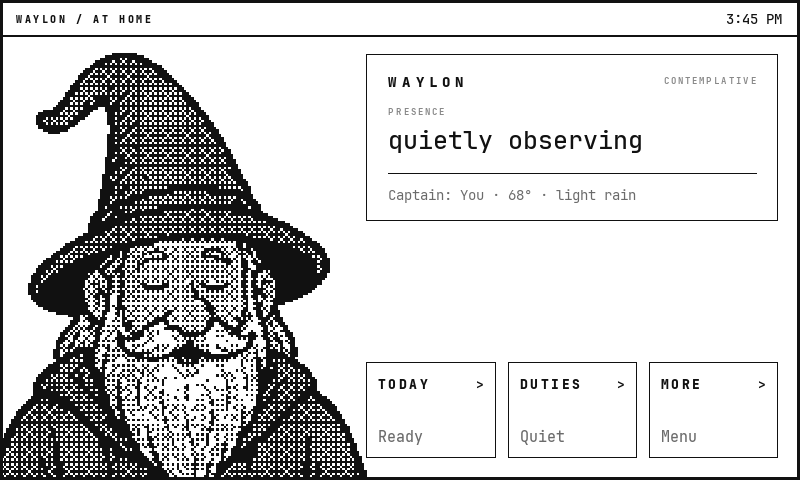
The screen
Raspberry Pi + a small touchscreen
A credit-card-sized computer with a small touchscreen. It’s where Waylon lives, where the day is read, and where every game begins and ends.
You: tap it, glance at it, or ignore it.
Ryan’s home project · 2026
A quiet presence at home, with small moments of ritual, choice and discovery.
Waylon is an old, peculiar, curious character who lives on a small screen in the kitchen. Mostly he just keeps watch. Sometimes he reads you the day. Sometimes he sends the kids across the house with a Stone in hand to find what went missing.
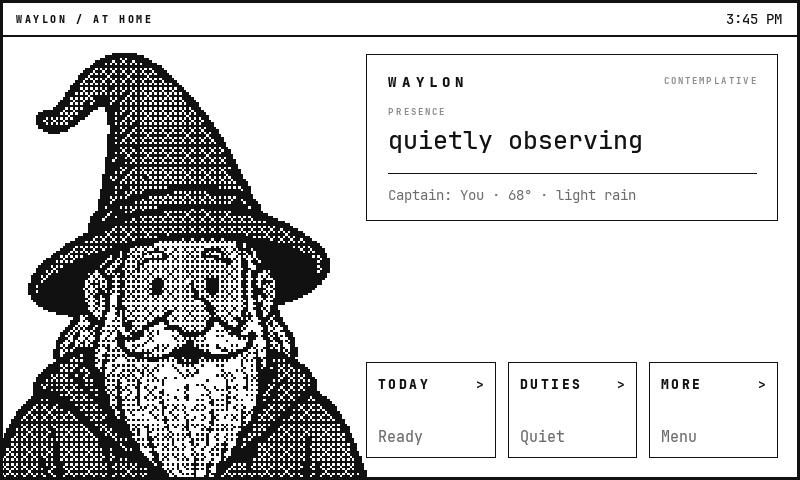
“Why do I do it? To see what happens.”
“Well. Now we know.”
Waylon is a designed character — calm, dry, a little old-fashioned. He is not a person and isn’t meant to stand in for one.
01 · A moment at home
The everyday use is small. Someone walking past the kitchen taps the screen to see what the day holds. It reads quietly by default; sound is always a choice.
Quiet presence. Waylon rests on the screen, blinking now and then. Nothing asks for attention.
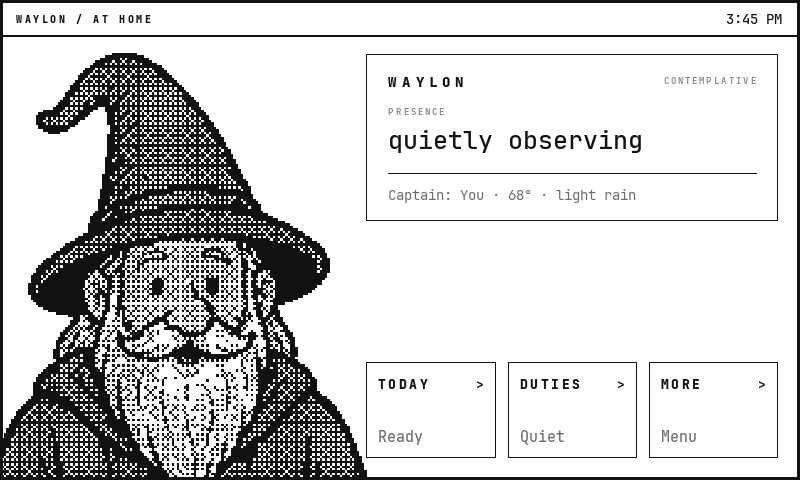
Tap TODAY. Waylon pulls in only what the household has allowed: the weather and the shared calendar.
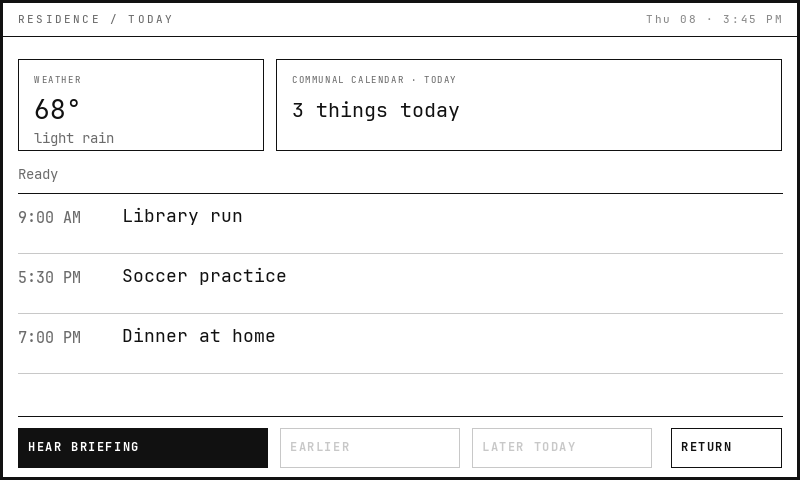
Read it at a glance. A plain overview, readable from across the room. Silent unless you ask.
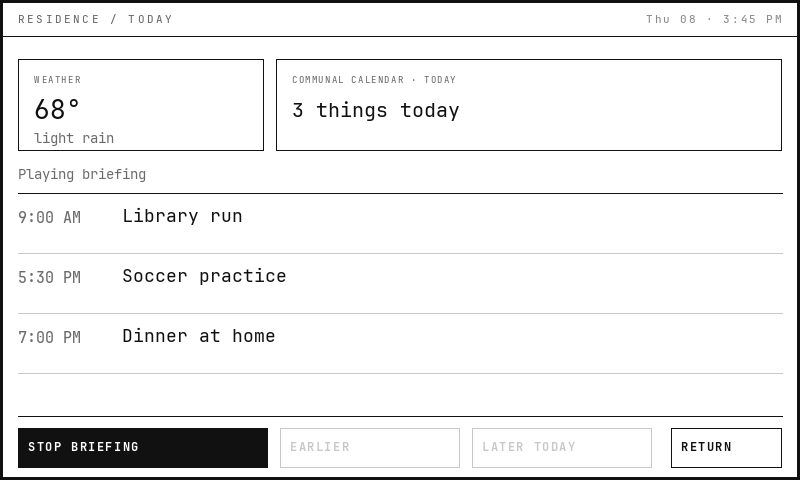
Hear it, if you like. HEAR BRIEFING reads it aloud. STOP BRIEFING, or going home, ends it.
Actual Waylon screens, rendered with example content. No household calendar is shown.
02 · The objects
No app to install, no headset. Everything happens through a screen on the counter, a small device in a child’s hand, and cards tucked around the house.
The screen
A credit-card-sized computer with a small touchscreen. It’s where Waylon lives, where the day is read, and where every game begins and ends.
You: tap it, glance at it, or ignore it.
The Stone
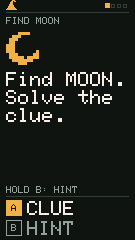
Small enough for a child’s hand. It shows a clue, glows warm when it’s waiting, and reads a card when you hold it close.
You: carry it through the house and scan what you find.
The cards
Reusable cards with a chip inside, placed around the house. Each holds a clue or a recovered word.
You: find one, tap the Stone to it.
The grown-up side
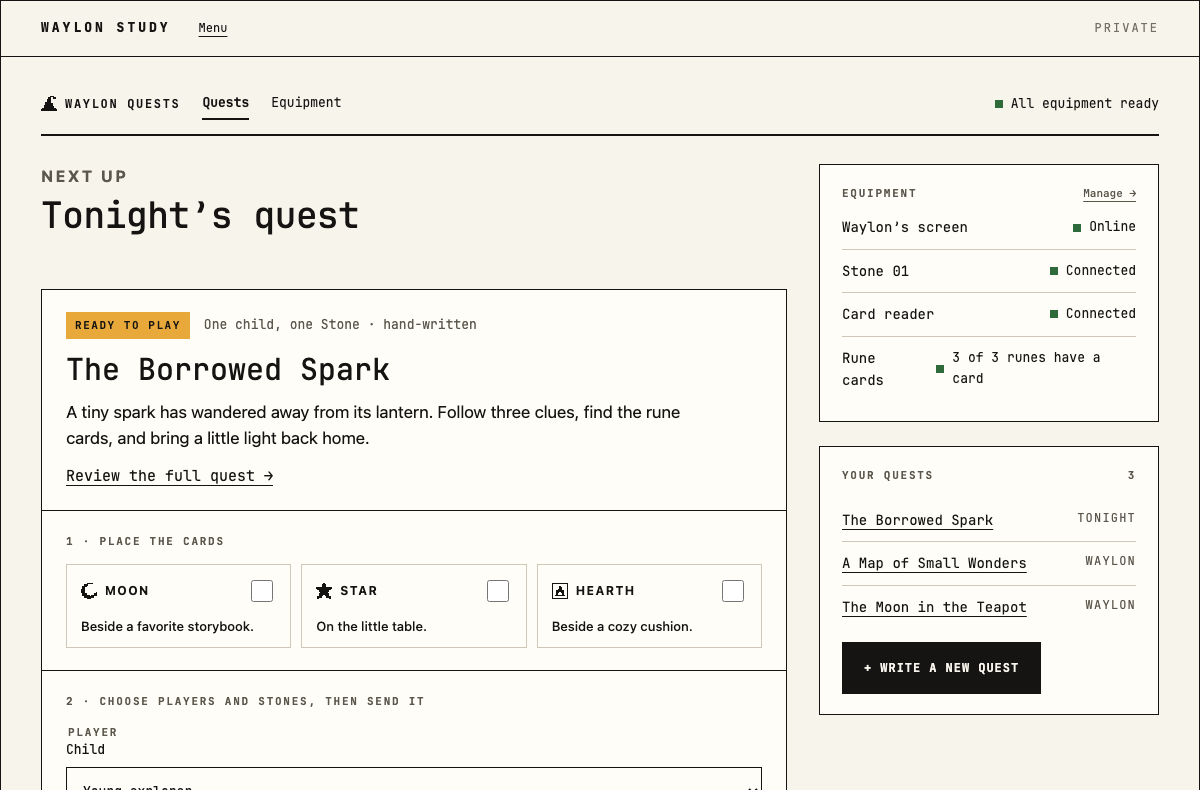
An adult guides it all from a private web workspace called the Study — choosing what Waylon can see, writing quests, and reviewing how things went. Children never need it.
The Pi is the source of truth. A small service called Cairn keeps the rules and facts of each game — who found what, which words are recovered — so nothing depends on a model remembering correctly.
Code owns facts; the character owns tone. Times, names, counts and weather come from application state. A language model may phrase an aside, never a fact on screen.
Stones are clients. Each Stone has two buttons, a small display and an RFID/NFC reader. It reports scans to the Pi and shows what it’s told.
Local-first, not offline-only. The system runs in the house, on the home network. That doesn’t mean every model runs offline — some requests may leave the house.
03 · Presence, ritual, exploration
The point isn’t the screen. It’s making the house itself a little more interesting — and in every game, the child holding the Stone is the hero, not Waylon.
Presence
Waylon keeps a calm watch. He notices the time of day, turns to white-on-black at night, and offers the occasional dry remark. The default state is stillness.
Quests
An everyday task gets a story and a few playful choices. In one, Waylon wakes to find someone borrowed my spark — and the kids have to get it back before bed.
Rounds
Short hunts through real rooms. Find the cards, recover the words, bring them home to the screen. See one below.
Waylon has lost the words to a spell. A child picks up a Stone; it warms to amber.
The Stone hints where to look. The Moon card is under the reading lamp.
Tap the Stone to the card. A word is recovered. Then the Star, then the Hearth.
Back at the screen, the child puts the words in order and casts the spell.
Playing together
Two players get different clues. What one discovers unlocks the next step for the other, so neither can finish alone. They split up, trade what they’ve found, and come back to the screen together.
04 · Behind the curtain
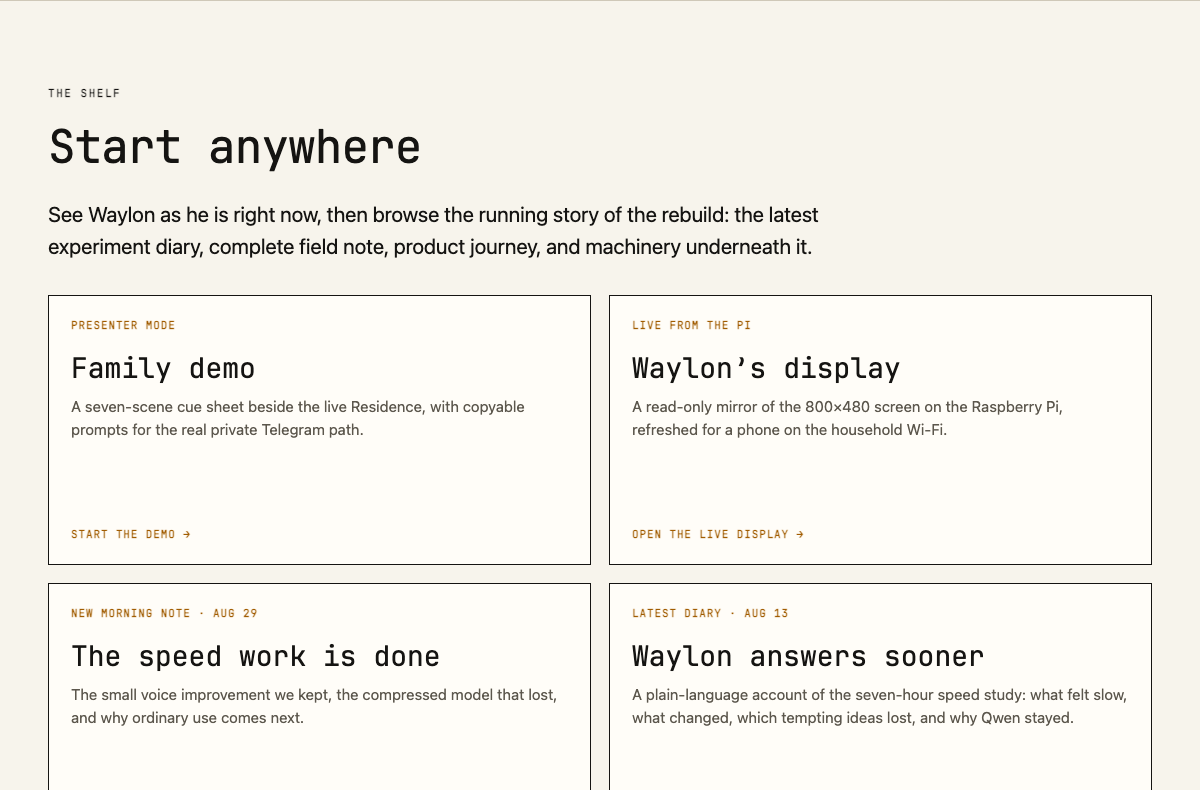
Two quiet web pages on the home network, for the adults. Same paper, same ink.
05 · Where it stands
UPDATED
A Raspberry Pi, a small screen and a few handheld Stones that make an ordinary house a bit more curious. Quiet by default. Playful when invited. Built and guided by a parent, with the kids as the heroes.